

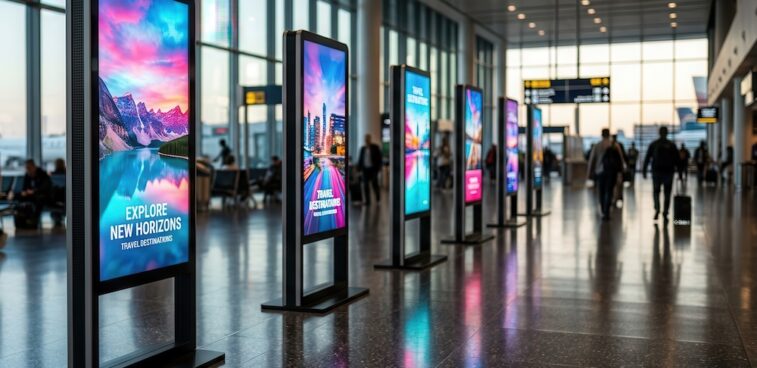

Demand and innovation are like the proverbial chicken and egg – which comes first? The reality is that they are often impossible to separate. Without demand, there’s no driver for innovation. Without innovation, there’s no opening up of new possibilities that fuels demand.
This is certainly the dynamic we’ve seen play out in digital signage over the past few years. The market has boomed in tandem with rapid proliferation in products, formats and technologies. One has driven the other. If there weren’t more and more businesses interested in using digital displays, there wouldn’t be the impetus that has seen multiple screen formats, cloud-based AV content systems, large scale video walls and much more emerge as established parts of the market.
At the same time, innovation and diversification stimulate demand by creating more choice. Nowadays, digital signage is available in a huge variety of sizes and shapes, with different resolutions, brightnesses, interfaces, media players and content controls to suit every combination of location and purpose you can think of.
What that does mean is that choosing digital displays is a little more complex than it once was. The range of options for how you can use digital signage, and the quality of the choices available, has never been better. But you have to know what formats and product types best suit which purpose.
One of the most fundamental decisions is choosing the type of screen to use for your signage. Here’s a breakdown of the three main screen types available, how they work, and when they work best.
In tech terms, LCD screens – short for liquid crystal display – are positively historic. The first functional LCDs, which use cathode fluorescent lamps to ‘backlight’ a screen from behind, were manufactured in the late 1960s. When modern digital signage as we know it emerged in the 2000s, LCD screens were the default standard. They are still going strong today. If you see a single regular display unit in a shop, restaurant, hotel or leisure venue, there’s a good chance it’s an LCD screen.
The reason is that LCDs are economical. As you’d expect from such a seasoned technology, they are cheap and easy to mass-produce. They are also very reliable. For conventionally sized indoor screens, where glare isn’t an issue, LCD displays are the cheapest option and can easily handle ultra-high definition (UHD) resolutions. That makes them a popular ‘workhorse’ option for everything from customer-facing point-of-sale screens to promotional displays to wayfinding.
LED screens replace the fluorescent backlighting lamps in LCDs with individual light-emitting diodes (hence the abbreviated name ‘LED’). The technology has also been around since the 1960s, but it was the 1990s before full colour LED screens became available.
The main advantage LED screens have over LCD is scalability. Because there’s no need for a lamp and the individual pixels (i.e. the diodes) act as the light source, it’s much easier to make very, very big screens.
LED technology has therefore been the driving force behind the development of the modern video wall display. By packing diodes into individual panels and then piecing those panels together, you can make screens of any size and shape. There are other advantages, too. Direct light emission allows LED screens to be brighter than LCD and less prone to glare, so they are better suited to outdoor environments. You can also choose different pixel densities to provide crisp, sharp images from different viewing distances.
The newest of the major screen technologies, epaper is best known for its role in e-readers, most famously in Amazon’s Kindle, which launched its first epaper devices in 2007. Epaper achieves its ‘ink-on-paper’ visual effect thanks to a process called electrophoresis, which manipulates charged pigment particles in a thin layer of fluid to build images.
With no light being emitted from the screen, epaper is easy on the eyes. But it is also exceptionally economical, eco-friendly and resilient, with minimal power consumption and a vastly reduced risk of component failures.
It’s these qualities that have seen epaper become a popular option in digital signage. It’s not what you’d choose for high definition video displays, retail media, or anything where on-screen content changes frequently. But for more static use cases like electronic shelf labels (ESL), digital posters, food and drink menus, event signage and wayfinding boards where content only needs to be changed occasionally, epaper offers a highly cost-effective alternative.
To talk about the best digital signage options for your business, get in touch with the Oxhoo team today.