

The local shop has always had more to it than just selling groceries. From lottery tickets to cash machines to bill payments, convenience store operators have long sought ways to provide extra services to their communities..
But in recent years, this expansion of services has gone into overdrive. A typical convenience store today might offer food-to-go, parcel collection, grocery deliveries and click-and-collect, along with partnership services such as a Post Office or pharmacy counter.
Some are going further still, adding everything from laundrettes and community libraries to locally produced gifts and restaurant-quality meal options.
The result is a new kind of store format that pushes the boundaries of traditional retail. Perhaps more than any other category, convenience is exploring the possibilities of formats and services that have previously sat outside the boundaries of retail. The emphasis is on serving the needs of the local community. And in doing so, creating a new type of multi-service hub.
There is, of course, sound business logic behind this shift. The Association of Convenience Stores’ 2025 Local Shop Report describes how competitive the convenience sector has come. With the likes of fuel forecourts and small-format supermarkets encroaching on traditional local shop territory, grocery sales in the convenience sector have stagnated while operating costs have continued to rise. The report forecasts that annual sales will dip to £48.8 billion from £49.4 billion the previous year.
Expanding the portfolio of services on offer in a local shop addresses this challenge in two ways. For one, services that stores can monetise directly represent new income streams and ease the reliance on grocery sales.
But just as importantly, offering a diverse range of services gives people more reason to visit their local shop. Generating additional footfall is known to correlate directly with increased sales. A customer collecting a parcel may also buy a drink. Someone stopping for a coffee might pick up lunch or a few household essentials. Each new service creates another reason to enter the store and another opportunity to make visiting the local shop part of an existing routine.
There are limits on just how many additional services any local shop can offer. The convenience sector is built on small store formats, after all. So there are space constraints to consider.
Convenience retail is also very much location dependent. The customer base is tightly linked to the local community, with varying amounts of passing trade. Understanding that community is key to deciding which mix of services will best match with customer’s needs. A store serving a residential suburb or rural village might benefit from offering very different services to one based in a student neighbourhood, or that attracts a lot of commuter trade.
Local connection is one of the sector’s greatest strengths. According to ACS, 32% of customers know the people working in their local shop well, while 80% of stores have taken part in community activity during the past year. The most successful new services will therefore be those that reflect how people in that particular area live, shop and spend their time.
It has to be acknowledged that as convenience stores look to expand their offer, the operational demands ramp up.
Staff may need to manage conventional retail purchases alongside food-to-go orders, parcel collections, and arranging home deliveries. Peaks in demand for different services can also shift throughout the day.
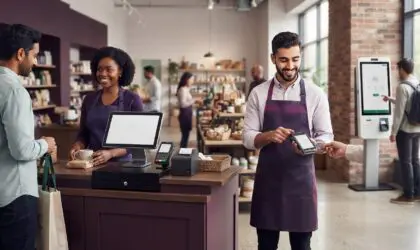
Technology has an important role to play. For starters, convenience store operators looking to add more services benefit from flexible POS solutions that can incorporate multiple types of transaction. Most convenience stores run a single checkout terminal. For ease of use for staff and to keep workflows smooth and efficient, it’s important to ensure that all services can be managed from this one touchpoint.
But at the same time, diversifying services also gives convenience store operators an incentive to consider expanding their POS footprint beyond the traditional till system. Self-service kiosks can help handle small sales more efficiently at busy times, especially if extra services are bringing more people into the store. You don’t, for example, want a queue of people waiting to send parcels to put off those who want to quickly grab a snack and a drink.
It’s also important to let customers know exactly what they can do in the store, and how. Customer-facing displays and digital signage can make an increasingly varied offer easier to navigate.
The objective is to help convenience stores become more useful, more varied and more attuned to the daily needs of the customer base they serve. The challenge now is to make that broader role feel as convenient as possible.
If you would like to talk more about POS solutions for your convenience store, please contact the Oxhoo team today.