
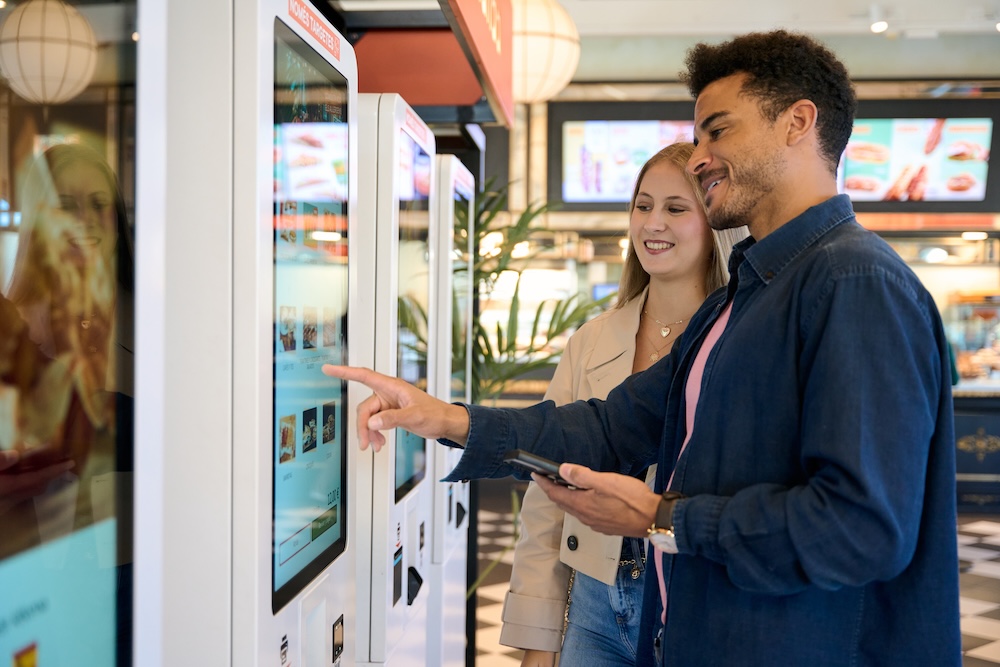
A recent article on the BBC website brought to the general public’s attention something that’s been an open secret in the retail and hospitality industry for years. The fact that the majority of people spend more when they use self-service kiosks than they do at staffed tills.
Quoting an uptick in average order value (AOV) of up to 40%, the article went on to divulge something else that comes as no surprise to retailers, restaurateurs and hotel and leisure operators. The reasons why kiosks get us spending more all come down to human psychology.
The piece gave a general overview of behavioural science and various ways it has been used to influence consumers en masse over the years. But we thought we could go one better than that. Because there’s plenty of research specifically on kiosks that lifts the lid on why people don’t just spend more when they use them, but spend more often.
Digital Disinhibition and the Removal of “Social Judgement”
The classic example of kiosks boosting AOV is the QSR self-ordering point. It’s why so many fast food chains have followed McDonald’s pioneering example over the past decade. The BBC jumped straight into the most commonly cited reason why people buy more fast food when they use a touchscreen in the article’s headline – “You don’t feel judged.”
For a lot of people, concerns about being judged for over-indulging in what are perceived as not-so-healthy food choices are very real. And a study by the University of Hamburg confirmed that, when there’s no social interaction involved in the ordering process, those concerns go away. So people order more.
But the idea of ‘digital disinhibition’ may run even deeper than that. Another study found a causal link between ordering via a screen and what it called ‘indulgent outcomes’. But suggested that this was because screens demand “lower cognitive involvement” than talking to a person. In other words, with a screen in front of us, we think about our decisions less. That leads to us being more impulsive and more indulgent.
Psychological Ownership of the Experience
The psychology of screen use is in itself a fascinating subject. The psychology of touchscreens even more so. Humans are visual creatures, and people routinely “buy with their eyes” based on attractive visual imagery. But a touchscreen adds another dimension to this. Even though it’s only an image on a screen, research shows that being able to physically touch attractive product visuals as part of the product selection process creates a psychological sense of attachment that results in a higher willingness to pay. Another study comparing purchasing behaviours on mouse-and-keyboard desktops versus touchscreen interfaces found that touchscreen users reported more satisfaction from the experience.
Perfect Sales Tactics
The effects of touch-based attachment and satisfaction, and judgement-free, low cognitive load decision-making on purchasing behaviour might be happy accidents of the kiosk format. But kiosks can also be used in very intentional ways to have just as significant a psychological impact on customers.
It’s more than just the fact that kiosks never forget to make a relevant upsell suggestion. Compared to a static menu or product merchandising in a store, it’s comparatively easy to build the choice architecture of interactive screens to influence people to make the decisions you want them to make (i.e. buy more). Good examples include decoy pricing, or the ‘three option rule’ where you purposefully inflate the price of a middle option, pushing it closer to the highest priced item than the lowest. This makes the highest priced item seem like better value. Another is simply setting the premium option as the default. People don’t like to feel like they are choosing down.
Understanding why kiosks influence people to buy more is a useful exercise. For one, influencing customers to buy is the core purpose of business. The more we understand what works, the better we can refine our approaches. High kiosk AOVs don’t just happen, and they don’t happen evenly across all use cases. Understanding what works in QSRs, for example, gives vendors in other categories valuable insights for how to get the most from self-service in their own contexts.